

Macedonian humor is a world of its own—rich, nuanced, and deeply connected to the language itself. If you’re learning Macedonian, diving into its humor is one of the best ways to truly grasp the language’s subtleties and quirks. A great way to start is by exploring jokes, sketches, and punchlines that play with words, accents, and colloquial expressions.
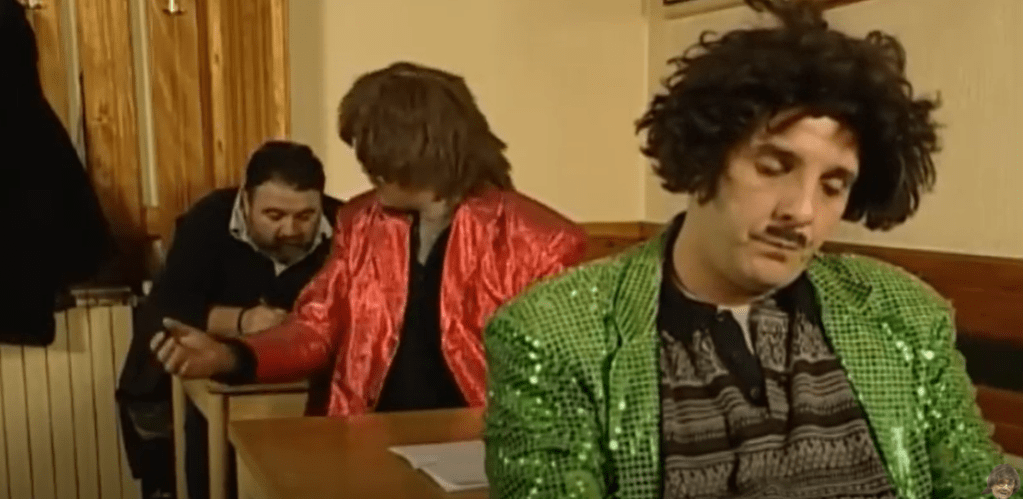
One shining example of this linguistic humor is a sketch by the iconic Macedonian comedy group K-15, featuring their famous characters:
- Цацко Конопишки (with a distinct accent from Eastern Macedonia, particularly Kavadarci),
- Тошо Малерот (a Skopje native with city slang), and
- Миле Паника (representing Ohrid with its unique speech patterns).
Their humor often mixes social critique with playful banter, using language as the primary tool to deliver laughs.
„А, бе, це!“
Let’s break down one of their classic sketches, „А, бе, це!“—a hilarious scene set during an exam. The humor in this sketch relies on Macedonian interjections, wordplay, and confusion.
Here’s how it unfolds:
Миле Паника is struggling during the exam and whispers to Тошо Малерот, asking for the answer to the second question:
- „Што заокружи на второто (прашање)?“
(What did you circle for the second question?)
Тошо replies: „Ц (це)!“ (C!)
But Mile doesn’t hear him and keeps asking:
- „Не те чув!“ (I didn’t hear you!)
- „Це, бе!“ (C, dude!)
Here, the humor kicks in because of the interjection „бе“, which Macedonians often use for emphasis or familiarity. It’s a casual word that doesn’t translate easily but adds personality to the conversation.
Still confused, Mile interprets the reply as either “Це” (C) or possibly “бе” (B). So, he asks again:
- „Це или бе?“ (C or B?)
Тошо clarifies emphatically by adding another interjection, „А, бе!“:
„А, бе, Ц!“ (It’s C, for sure!)
The interjection „а, бе“ adds even more emphasis, showing frustration or urgency.
Meanwhile, Цацко, the third character, has had enough of their chatter and jumps in with another interjection:
- „Де, бе! А, бе, це!“ (Come on, it’s C!)
The word „де“ is yet another interjection used to urge someone to hurry up or express mild exasperation.
Finally, in true Mile Panika fashion, he misunderstands everything, declaring:
- „Кај мене нема де, бе!“ (I don’t have any Ds, dude!)
His confusion climaxes when he circles all three options: A, B, and C—a brilliant punchline that leaves viewers in stitches.
Breaking Down the Humor
This sketch is a masterclass in Macedonian linguistic humor. Here’s why:
1. Interjections as Humor: Words like „бе“, „а, бе“, and „де“ are quintessentially Macedonian. They don’t have direct translations but serve to highlight, emphasize, or encourage. Their overuse creates comedic tension and misunderstanding in the scene.
2. Wordplay and Puns: The misunderstanding between ‘a’, ‘бе’, ‘це’, and “де” is a classic example of how humor can stem from linguistic ambiguity.
3. Macedonian humor thrives on the interplay of accents, colloquialisms, and cultural context. Even something as simple as exam answers can turn into a comedy goldmine when interjections and misunderstandings come into play.
If you’re learning Macedonian, immersing yourself in this type of humor is an excellent way to:
– Expand your vocabulary (especially with slang and interjections),
– Understand how colloquialisms shape meaning,
– Appreciate the cultural nuances that make Macedonian such a lively and expressive language.
So, grab a cup of coffee (or пивце, if you prefer) and dive into the world of K-15 sketches. You’ll not only laugh but also learn!
*If you’re an advanced learner of Macedonian, K-15 sketches can be a fun yet challenging way to engage with the language. For beginners or intermediate learners, these sketches might feel overwhelming or even misleading, as they sometimes deviate significantly from standard Macedonian.

If you’re still building your Macedonian skills and want to feel confident before tackling advanced content like K-15, check out my comprehensive 70-page Macedonian Language Crash Course! It covers everything you need—from the alphabet and essential vocabulary to grammar rules and conversational phrases—to help you build a solid foundation and start speaking Macedonian with ease.

 Macedonian Language Corner